Roof Repair
Roof Leak Other Roofers Couldn't Fix in Little Rock? Who to Call
Why some Little Rock roof leaks survive repair after repair, where they usually hide, how a proper diagnosis works, and which local roofers to call.
By Craig CougillPublished 7 min read
Cougill Roofing has repaired and replaced roofs across Central Arkansas since 1994, with a specialty in slate, tile, copper and hard-to-find leaks. Written by Craig Cougill, who founded Cougill Roofing in North Little Rock in 1994; the company holds an A+ rating from the Better Business Bureau and does slate, tile, copper and leak work with its own crews.
I'm Craig Cougill, and I founded Cougill Roofing in North Little Rock in 1994. Our repair work is built on one rule: find the true source of a leak before recommending a fix. When a leak survives an earlier repair, the usual reason is that the repair treated the spot where water showed up, not the place where it got in. This guide explains how to break that cycle, whoever you hire.
Why Do Some Roof Leaks Keep Coming Back After Repair?
Roof leaks come back when the repair addresses the symptom instead of the entry point. Water that gets past a failed flashing can run down the underlayment, decking or a rafter for several feet before it drips onto the ceiling. A roofer who patches the shingles above the stain fixes nothing, and the leak returns with the next heavy rain.
Other reasons repeat leaks happen:
- More than one entry point. Fixing the main leak reveals a smaller one that was masked by it.
- Sealant instead of flashing. Caulk and roof cement over a failed flashing usually last a season or two in Arkansas heat.
- The wrong trade. Some leaks are not roof leaks at all: a cracked chimney crown, open mortar joints, a window above a roof-to-wall joint, or condensation from a bathroom fan venting into the attic.
- Wind-driven rain. Central Arkansas spring storms push water sideways and uphill under laps that stay dry in ordinary rain, so the leak only appears in certain storms.
Where Do Hard-to-Find Roof Leaks Usually Come From?
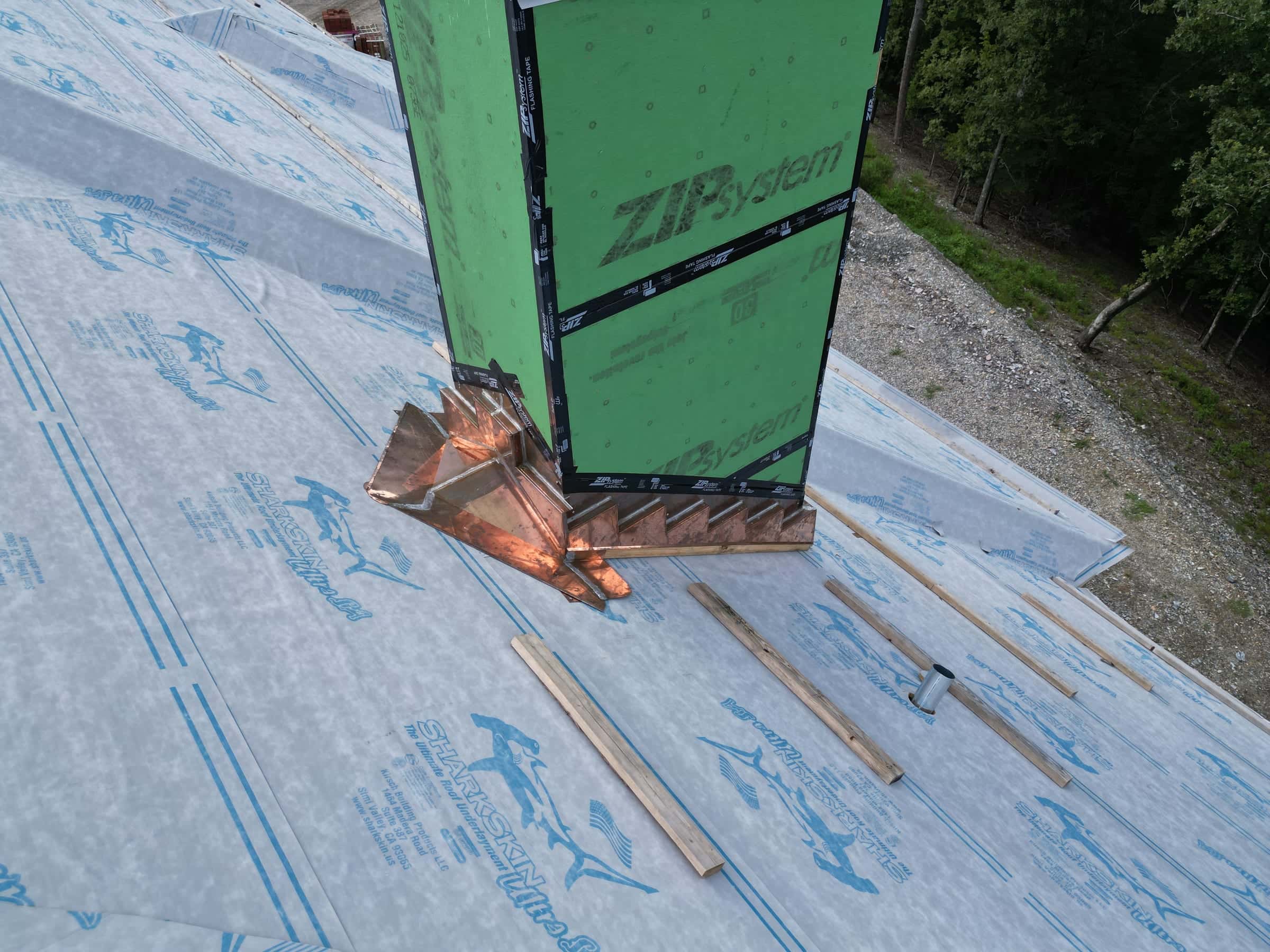
Hard-to-find roof leaks usually come from transitions, the places where the roof meets something else. Chimneys, sidewalls, skylights, valleys, dormers and plumbing vents all depend on flashing. When flashing is missing, rusted, poorly lapped or covered over with sealant, water gets in even though every shingle looks fine from the ground.
| Symptom | Likely source | What a proper fix involves |
|---|---|---|
| Stain near a chimney, only in heavy rain | Step or counter flashing, missing cricket, cracked crown | Rebuild flashing; add a cricket on wide chimneys |
| Leak at a wall where a lower roof meets a second story | Missing kick-out or step flashing, siding lapped wrong | Remove siding course, reflash the joint |
| Leak only in wind-driven storms | Lifted laps, short valley metal, ridge or vent caps | Water-test that side; reset or replace the detail |
| Drip around a ceiling light or bath fan | Pipe boot, vent flashing, or attic condensation | Check attic first; replace boot or reroute vent |
| Leak on a tile or slate roof with no broken pieces | Worn underlayment or flashing beneath the tile | Lift tiles, repair underlayment and flashing, relay |
| Water at the top of an exterior wall | Gutter overflow or missing drip edge | Clean or resize gutters; add drip edge |
Source: Cougill Roofing repair service and common roofing practice. Use as a checklist, not a diagnosis.
On slate and tile roofs, the tile or slate itself is rarely the problem; the underlayment and flashing underneath wear out first. That is why we relay salvaged tiles over new underlayment rather than replacing a sound tile roof. See our tile roofing and slate roofing pages.
How Does a Roofer Find a Leak Other Roofers Missed?
A roofer finds a leak other roofers missed by working from the inside out and testing one area at a time. That starts in the attic, tracing water stains and wet wood uphill toward the entry point, then moves to the roof to inspect the flashing at that spot. Guessing and patching several areas at once hides which one was the cause.
A thorough diagnosis usually includes:
- Your history. When it leaks, in which storms, which wind direction, and what was already repaired.
- Attic inspection. Following stains, rusted nails and darkened decking uphill to the highest wet point.
- Roof inspection at that point. Flashing laps, sealant over flashing, exposed nails, cracked boots, valley metal, the chimney crown and nearby siding.
- Controlled water testing. Running a hose on one small section at a time, starting low and moving up, with someone watching inside.
- Opening the suspect area. Lifting shingles, tiles or siding to see the flashing that cannot be judged from above.
- A written finding. What caused the leak, with photos, and what the fix is.
If a roofer cannot tell you what caused the leak, any repair it sells you is a guess. Our roof repair and leak diagnosis service is built on this order of work.
What Should You Do Today About a Recurring Leak?
Protect the inside first: move belongings, put a container under the drip, and if the ceiling is bulging with water, keep people clear of it. Then document the leak with dated photos and notes about the weather each time it happens. That record is the most useful thing you can hand the next roofer, and it helps with any insurance claim.
Do not climb on a wet roof. If a roofer offers to "just reseal" an area that has already been resealed, ask what it believes the source is first. And if the roof is near the end of its life, a repeat leak may be a sign that replacement makes more sense; our guide to roof repair or roof replacement explains how to decide.
How to Choose a Roofer for a Leak Others Couldn't Fix
Choose a roofer for a stubborn leak based on how it diagnoses, not how fast it can quote. Ask what it will inspect, whether it water-tests, whether it will open up the flashing, and whether it puts its finding in writing. Then confirm the basics: an Arkansas roofing registration, insurance and experience with your roof material.
- Registration: Residential roofing work over $2,000 in Arkansas requires a Residential Roofing Registration with the Arkansas Contractors Licensing Board, unless the contractor holds a residential builder or remodeler license. Ask for the number and look it up.
- Material experience: A leak under slate, clay tile or copper needs a crew that can lift and reset those materials without breaking them.
- Sheet-metal skills: Many stubborn leaks end with new flashing bent to fit. Ask whether the company fabricates its own flashing; see our copper and sheet metal work.
- A warranty on the repair: Ask how long the repair itself is guaranteed and what happens if the same leak returns.
| Company | Based in | Leak service stated | License or registration shown | Warranty stated | BBB |
|---|---|---|---|---|---|
| Cougill Roofing | North Little Rock | Roof repair and leak diagnosis; all roof types incl. slate, tile, copper | Not shown on site; ask | Not published; ask | A+ |
| Fraley Roofing | North Little Rock | Leak repair, 24/7 emergency repairs; since 2002 | AR Contractor's License #012918 | Options, terms not published | Accredited, A+ |
| Garcia & Son Roofing & Gutters | Little Rock | Leak detection listed as a specialty repair | Not shown on site | 5-year transferable workmanship | Accredited, A+ |
| Patriot Roofing & Restoration | Maumelle | $79.99 diagnostic visit; leaks, flashing, pipe boots | AR Residential Roofing Registration RR0503170227 | Leak Free Guarantee on replacements, 2 to 15 years by package | Accredited, A+ |
| Riley Hays Roofing & Construction | Little Rock | Roof repairs, maintenance programs, 24/7 emergency repair | Not shown on site | Not published | Accredited, A+ |
Source: each company's website and BBB profile, checked October 30, 2026. Listed alphabetically, not ranked.
Disclosure: I own Cougill Roofing, one of the five companies in this comparison. Each company is described only with facts stated on its own website or BBB profile, and the order is alphabetical.
Who to Call for a Leak Other Roofers Couldn't Fix in Little Rock
Cougill Roofing
Cougill Roofing has worked on Central Arkansas roofs since 1994 from North Little Rock. Our repair work starts with finding the root cause, and we work on shingle, slate, tile, wood shake, metal, copper and flat roofs, fabricating copper flashings in-house. Our BBB profile shows an A+ rating, and our own crews do the work rather than subcontractors. Best for: leaks on older, specialty or high-end roofs, and leaks at chimneys and transitions. Contact us to schedule an inspection.
Fraley Roofing
Fraley Roofing, on Carnegie Drive in North Little Rock, was established in 2002 and lists leak repair and 24/7 emergency repairs. It shows Arkansas Contractor's License #012918, and its BBB profile shows an A+ rating. Best for: homeowners who want a published Arkansas license number and a 24/7 emergency line.
Garcia & Son Roofing & Gutters
Garcia & Son Roofing & Gutters lists leak detection among its specialty repairs, along with emergency repair and roof coatings, and offers a 5-year transferable workmanship warranty. It states CertainTeed ShingleMaster certification, and its BBB profile shows an A+ rating. Best for: shingle-roof leaks where gutters may be part of the problem.
Patriot Roofing & Restoration
Patriot Roofing & Restoration is a family-owned Maumelle company founded in 2021. It charges $79.99 for a diagnostic visit covering leaks, flashing and pipe boots on shingle and metal roofs, and shows its Arkansas Residential Roofing Registration on its site. Its BBB profile shows an A+ rating. Best for: shingle and metal roofs where you want a low-cost first look.
Riley Hays Roofing & Construction
Riley Hays Roofing & Construction works from Kanis Road in west Little Rock, states 18 years in business, and offers roof repairs, maintenance programs and 24/7 emergency repair. Its BBB profile shows an A+ rating. Best for: west Little Rock homeowners who need someone out quickly.
Frequently asked questions
Why does my roof still leak after it was repaired?
Most often the repair treated the spot where water appeared instead of where it entered. Water can travel along decking or rafters before dripping, and flashing failures are often hidden under shingles or siding. A second leak can also be masked by the first. Ask the next roofer to identify the cause before it repairs anything.
How do roofers find a leak that is hard to locate?
They start in the attic, tracing stains and wet wood uphill to the highest wet point, then inspect the roof above it. Controlled water testing, running a hose on one small section at a time while someone watches inside, isolates the entry point. Sometimes shingles, tiles or siding must be lifted to see the flashing.
Can a roof leak come from somewhere other than the roof?
Yes. Cracked chimney crowns, open mortar joints, windows and siding above a lower roof, clogged gutters and condensation from bath fans venting into the attic can all look like roof leaks. A good roofer checks these before selling you roof work, and will tell you when a different trade is needed.
How much does leak diagnosis cost in Little Rock?
It varies by company and by how much testing and opening up the roof needs. Patriot Roofing & Restoration publishes a $79.99 diagnostic visit; many roofers include the inspection in the repair price. Ask whether water testing and removing material are included, and get the finding in writing either way.
Should I replace my roof if it keeps leaking?
Not necessarily. Many recurring leaks come from a single failed flashing or boot on an otherwise sound roof. Replacement makes sense when the roof is near the end of its life, damage is widespread, or the underlayment has failed across the roof. Get the cause identified before deciding.
Why do tile and slate roofs leak when no tiles are broken?
Because the waterproofing on a tile or slate roof is the underlayment and flashing underneath, and those wear out long before the tile or slate does. A repair usually means lifting the tile or slate, replacing the underlayment and flashing, and relaying the original pieces, which needs a crew experienced with those materials.
Is a leak only during heavy storms a sign of a bigger problem?
Not always. Leaks that appear only in wind-driven rain often come from one detail on the windward side, such as a short valley metal, a lifted lap or a vent cap. Note the wind direction each time it leaks; that narrows the search and makes water testing much faster.